Dice and Their Uses

Updated: Mar 3, 2025
A Brief History of Dice
The history of dice is a long and fascinating one, stretching back thousands of years.
Ancient Origins:
Dice, or their precursors, are among the oldest gaming tools known. Evidence suggests they developed from ancient practices of divination and fortune-telling.
Early forms of dice included knucklebones (the ankle bones of animals).
Archaeological discoveries in places like the Indus Valley and ancient Egypt reveal dice dating back to around 3000 BCE and earlier.
Early dice were made from various materials, including bone, ivory, stone, and clay.
Development and Spread:
Dice were used in ancient civilizations for both games and rituals.
They spread throughout the world, with evidence of their use in ancient India, Greece, and Rome.
The Romans, in particular, were avid dice players.
Mathematical Analysis:
In the 16th century, mathematicians like Girolamo Cardano and Galileo began to analyze dice games, laying the groundwork for the study of probability.
Modern Dice:
Today, dice are commonly made of plastic.
They are used in a wide variety of games, from classic board games to role-playing games.
The development of polyhedral dice (dice with more than six sides) has added to the complexity and variety of dice-based games.
In essence, dice have been a part of human culture for millennia, evolving from simple tools of chance to integral components of complex games.
Polyhedral dice are absolutely fundamental to the tabletop role-playing game (TTRPG) industry. Here's a breakdown of their importance:
Varied Probability:
TTRPGs rely on chance to determine the outcomes of actions. Polyhedral dice, with their varying numbers of sides (d4, d6, d8, d10, d12, d20), allow for a wide range of probabilities. This is crucial for simulating the unpredictable nature of adventures.
For example, the d20 is iconic in games like Dungeons & Dragons, where it's used for crucial rolls like attack hits and skill checks.
Game Mechanics:
Different dice are used for different purposes within games.
For instance:
d4s might determine the damage of a small weapon.
d8s or d12s could be used for larger, more powerful attacks.
d10s are often used for percentage-based rolls.
Immersion and Engagement:
Rolling physical dice adds a tactile and engaging element to gameplay.
The suspense of a roll can heighten the drama of a situation, making the experience more immersive.
Industry Standard:
The "standard" polyhedral dice set (containing d4, d6, d8, d10, d12, and d20) has become a staple of TTRPGs.
This standardization allows for consistency across different games and systems.
Creative Expression:
Dice come in a vast array of colors, materials, and designs, allowing players to express their personal style.
This has led to a thriving market for specialized and collectible dice.
Dice & their uses in TTRPG:
D1 (Möbius Strip) Used when there can only be one desired result.
D2 (Möbius Strip) Used when there are only two possible results.
D3 (Prism or double-Möbius Strip) Determines how many times an ability can be used.
D4 Small weapons damage, healing
D5 Generally not used in TTRPG.
D6 Determines damage.
D7 Determines hit location.
D8 Large weapons damage
D9 Generally not used in TTRPG
D10 Large damage rolls, certain spell damage/effects
D12 Used for determining battle damage, as well as determining hit points.
D14 Generally used for weather rolls.
D20 Used to determine if an attack was successful; attacks. Saving throws, skill checks, & ability checks.
D24 Non-standard uses in TTRPG.
D30 Non-standard uses in TTRPG.
D50 Replaces percentile dice [D20] or another die.
D100 & D120 Determines percentages, saves, or spells-to-hits. Can also be used to determine if a spell can be cast, or success when mixing two potions together.

Figure 1 Mobius Strip, D1 & D2

Figure 2 D3

Figure 3 D4

Figure 4 Classic D6

Figure 5 D7

Figure 6 D8
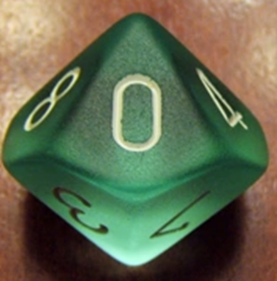
Figure 7 D10

Figure 8 D12

Figure 9 D14

Figure 10 D20

Figure 11 D24
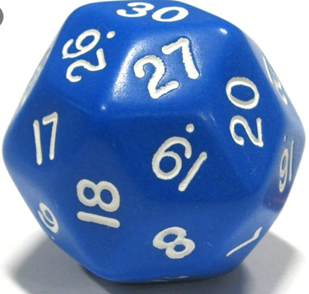
Figure 12 D30

Figure 13 D100

Comments